History
St Brendan’s Well
St John the Evangelist, Coolock, stands beside the Santry River at Tonlegee Road on a site with long Christian associations. Local tradition connects the site with St Brendan the Navigator, and the site of St Brendan’s Well lies on the opposite bank of the river.
The Viking Era
The church preserves important reminders of the area’s early history, including a plain granite cross and the base millstone of a horizontal water mill, both traditionally dated to the 9th century.
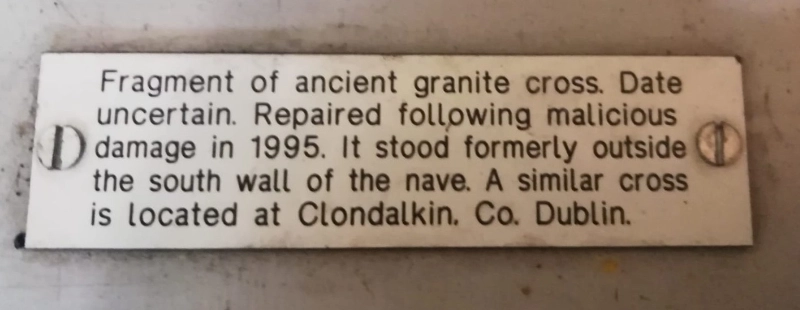
Granite cross
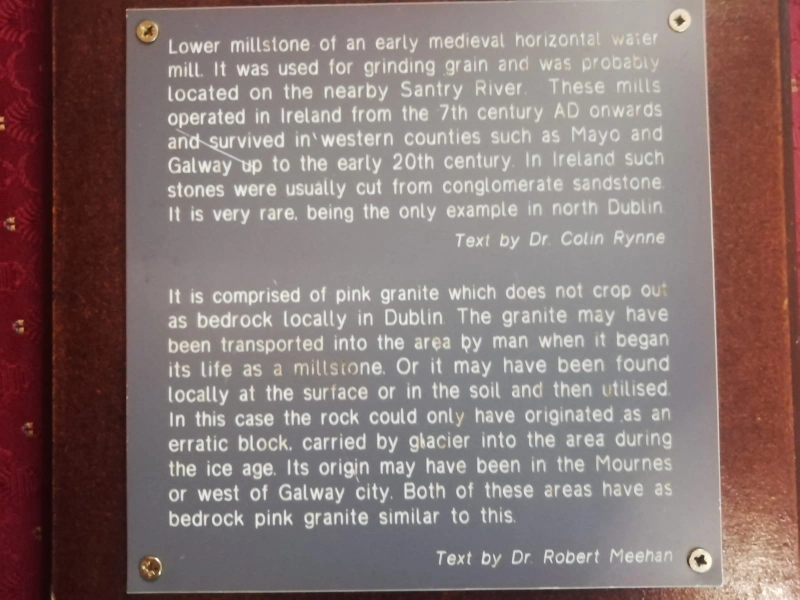
Millstone
Coolock Brooch
Archaeological finds from the vicinity also point to early medieval activity, including a bronze penannular brooch recorded in excavation reporting. The brooch is now held by the National Museum of Ireland, together with later finds from the area.
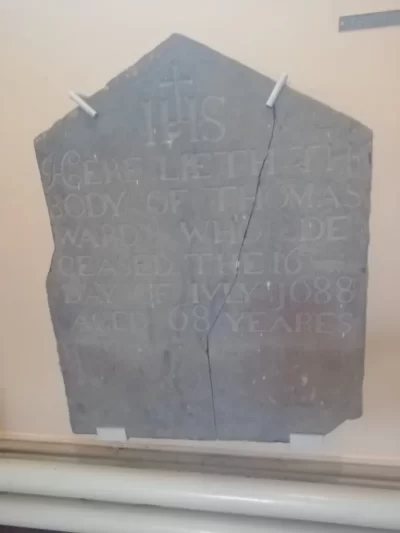
Gravestone dated 1688
Within the church is an inscribed gravestone dated 1688, the earliest dated stone preserved on the site.

St John’s Today
The present church, built on the site of an earlier ruined church, was consecrated on 21 September 1760 and dedicated to St John the Evangelist.
St John’s is especially notable for its stained glass, with windows attributed to Edward Burne-Jones, Morris & Co., Alfred E. Child, Sarah Purser’s An Tur Gloine, and Mayer & Co. of Munich.
Originally serving a small rural parish of farms and country houses, St John’s now serves a diverse urban community, while continuing its calling to worship God and serve its neighbours.
Timeline
c 1500 BC
Bronze Age burial in the Coolock area
|
c 600 AD
Early Christian foundation
|
12th – 13th century
Medieval parish develops under Norman administration
|
1579
Marmaduke Middleton instituted
|
1760
Present church built
|
1878
Restoration (fire)
|
1920
Union of Raheny and Coolock proposed
|
1924
Union of Coolock and Glasnevin and Santry
|
1960
Union of Raheny and Coolock
|
Today
A welcoming parish service the local community